The migration plan made it clear which parts of our old platform could move directly and which parts required new Magento implementation.
Magento Website Migration Service
Move an existing ecommerce website to Magento with structured source assessment, data and content mapping, target preparation, validation, and cutover planning.
MAGEHEX DELIVERY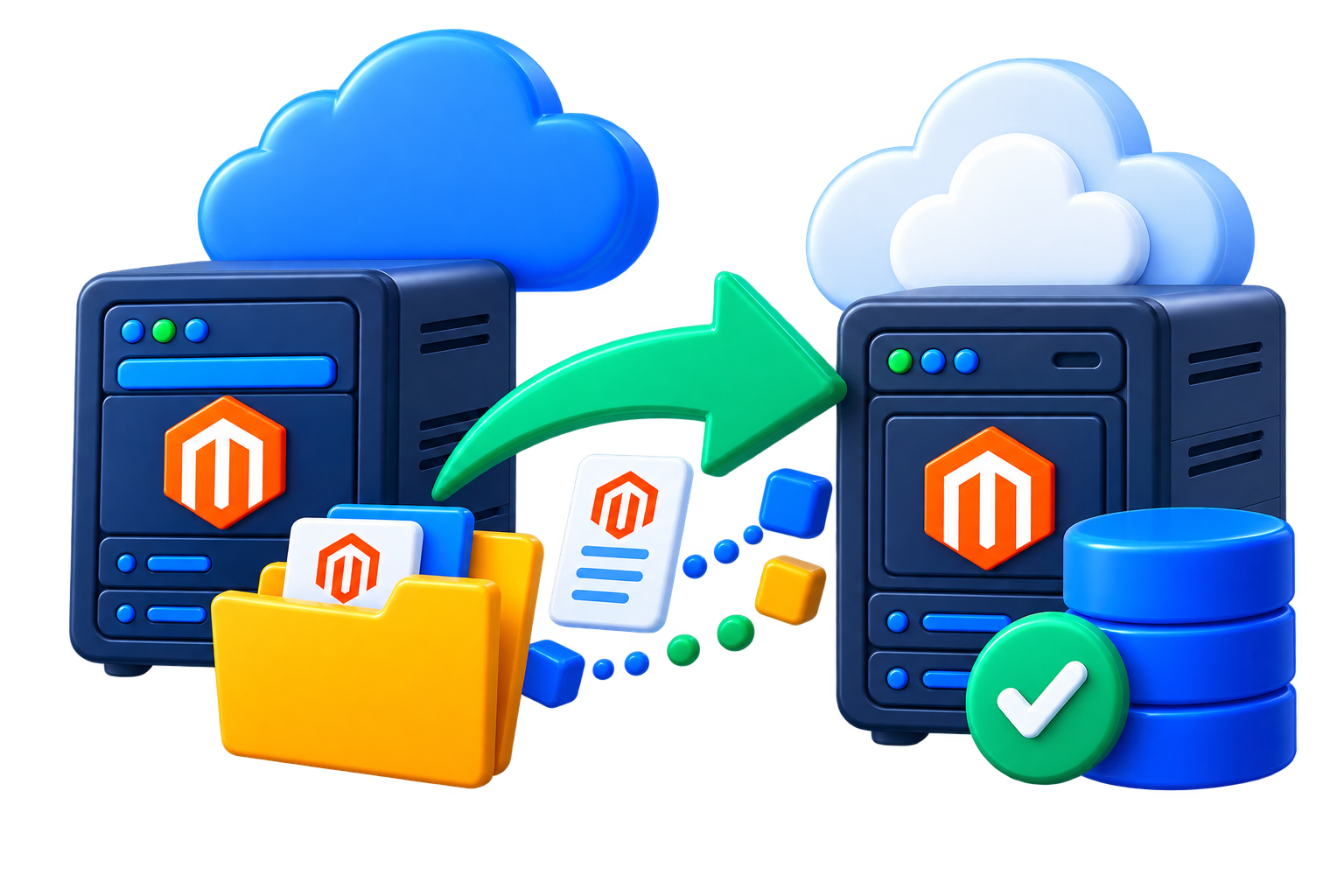
Service typeMagento website migration
ProcessAssess, map, migrate & validate
Best forBusinesses moving an existing website to Magento
Service overview
Move Your Existing Website to Magento with a Structured Migration Plan
Service scope
MageHex helps migrate an existing ecommerce website to Magento by defining the source platform, target Magento environment, data scope, content requirements, storefront dependencies, and integration needs before implementation.
Website migration is broader than a simple data import. Theme, URLs, customer and order data, integrations, business rules, and cutover planning may all affect the final scope.
What We Review
Source Website
Review the source platform, available exports or APIs, data quality, content, URLs, and existing ecommerce behavior.
Target Magento Store
Confirm the Magento edition, environment, store structure, configuration, and technical readiness.
Migration Scope
Define which catalog, customer, order, content, media, URL, and configuration data should move.
Storefront & Integrations
Identify theme, checkout, payment, shipping, search, analytics, and third-party dependencies that must be rebuilt or reconnected.
Website Migration Process
01 - Assessment
Review the source website, target Magento environment, available data, and business requirements.
02 - Mapping
Map source entities, fields, content, URLs, and business rules to their Magento targets.
03 - Preparation
Prepare the target Magento environment, migration method, backups, and validation approach.
04 - Migration
Move the approved data and content using the agreed migration method.
05 - Validation
Check migrated records, storefront content, URLs, and relevant business workflows.
06 - Cutover
Prepare the production transition, final synchronization where applicable, and post-migration verification.
What We May Migrate
- Products and categories
- Customer records where permitted
- Order history where technically appropriate
- CMS pages and content
- Images and media where available
- Selected URLs and redirects
- Store configuration in scope
- Reference data required by the approved migration
Customer Prerequisites
- Access to the source website and available export or API methods.
- Access to the target Magento environment.
- A defined list of data and content that must be migrated.
- Information about theme, checkout, payment, shipping, and integration requirements.
- A decision for source features that do not map directly to Magento.
- Appropriate backups and cutover coordination.
Project Considerations
Migration scope and risk depend on the source platform, data quality, custom functionality, integrations, and target Magento requirements.
No zero-downtime, complete feature parity, automatic compatibility, or identical URL behavior is implied unless it has been explicitly validated and agreed.
Why Choose MageHex
Source-to-Target Planning
Migration starts with explicit mapping between the old website and the target Magento structure.
Data Validation
Migrated records and content are checked against the agreed source and target requirements.
Magento Context
Store structure, configuration, theme, and integrations are considered as part of the transition.
Controlled Cutover
Production transition is planned separately from the bulk data transfer itself.
FAQ
What websites can be migrated to Magento?
Migration is possible from many platforms when the required source data, access, and business rules are available, but the exact path depends on the source system.
What data can be migrated?
Common scope can include products, categories, customers, orders, content, media, URLs, and selected configuration, subject to source availability.
Is this the same as Magento Data Migration Service?
No. Website Migration covers a broader platform transition, while Data Migration can focus on defined datasets between systems or Magento environments.
Will my old theme move directly to Magento?
Usually not. Storefront design often needs to be rebuilt, adapted, or replaced for Magento.
Can URLs and redirects be preserved?
Relevant URL mapping and redirects can be included when the source data and target structure allow it.
Can third-party integrations be migrated?
Integrations normally require separate review because APIs, credentials, workflows, and provider behavior differ between platforms.
Can you guarantee zero downtime?
No. Cutover depends on the source system, migration method, synchronization needs, and project plan.
What should be prepared first?
Provide source access, target Magento access, required datasets, storefront requirements, business rules, integration details, and the expected cutover approach.
Customer feedback
What Our Customers Say
Mapping the product, customer, and order data before migration prevented several field and identifier issues later.
Our source website had custom URLs and integrations, so treating the migration as more than a basic import was important.
The validation stage helped us compare the migrated catalog and content against the source before planning the cutover.
A useful service for businesses moving to Magento when data, content, URLs, and operational workflows all need coordinated planning.
The distinction between data migration, storefront work, integrations, and final cutover made the project easier to manage.
Related services
Related Services
 Magento services
Magento service
Magento Data Migration Service
Plan and execute Magento data migration with defined source-to-target mapping, controlled transfer, validation, reconciliation, and cutover preparation.
View service → Magento services
Magento service
Magento Integration Service
Connect Magento with external business systems and APIs through defined data flows, authentication, synchronization logic, error handling,…
View service → Magento services
Magento service
Magento Store Setup Service
Prepare a Magento store foundation with structured configuration of store scopes, locale, currencies, customers, sales, tax, shipping,…
View service → Magento services
Magento service
Magento Support & Maintenance Service
Keep your Magento store maintained with structured technical support covering issue investigation, platform upkeep, compatibility checks, security…
View service →